
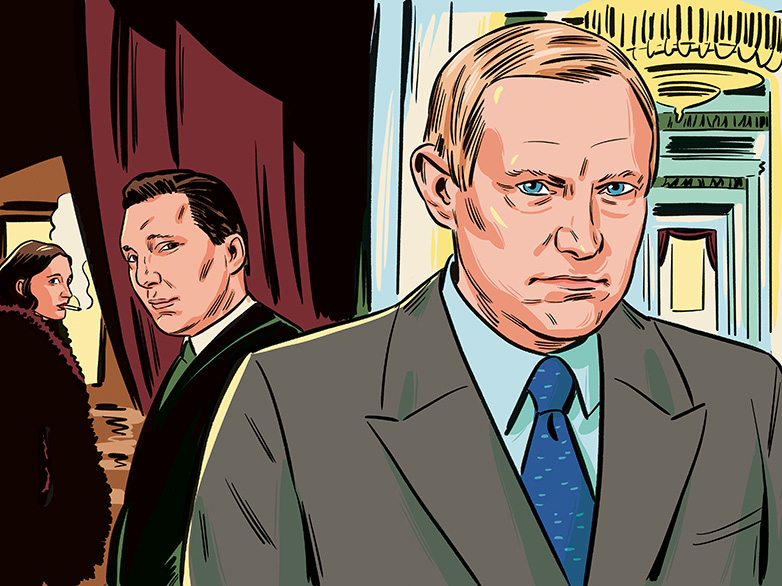
When Le Mage du Kremlin (The Wizard of the Kremlin) was published in France in April 2022, two months after Russia’s invasion of Ukraine, it was a huge success, both commercially and critically. Its portrayal of Vladimir Putin’s rise to power at the hands of an opportunistic special adviser – called Vadim Baranov in the novel but based on the real-life figure of Vladislav Surkov – seemed to offer gratifying insight into the Russian president’s entire career and mode of operation.
Its author, Giuliano da Empoli, had artfully combined a racy, potted history from the fall of the Soviet Union to Putin’s ascendancy with a series of aphoristic assertions about politics that seemed to place the book in the tradition of the classic French moralists, not forgetting to throw in a soupy romance. When I reviewed the translation for the New Statesman in 2024, it struck me as a cross between Jeffrey Archer and the trite French lifestyle novelist Frédéric Beigbeder, but keener students of political infighting enjoyed it more.
A year after publication, Da Empoli admitted that he would not have wanted, or been able, to write the book after the war in Ukraine: “I was able to get inside a Russian’s head at a time when the atrocious conclusions of the Putin regime were not yet fully visible and unfolding.”
Here, nonetheless, is the film adaptation from the director Olivier Assayas and writer Emmanuel Carrère, both of whom I greatly admire. Its cast, moreover, includes Paul Dano as Baranov, Jude Law as Putin (or “the tsar”) and Alicia Vikander as the love interest, Ksenia. It is, I regret to report, more or less a complete dud, not only because it has been overtaken by events in Putin’s war against Ukraine but because its earnest, unimaginative fidelity to its source exposes the novel’s superficiality.

The structure is creakingly antique, worthy of an Edwardian ghost story. An American academic (the venerable Jeffrey Wright) arrives in Moscow for a sabbatical and is mysteriously summoned one night to the splendid dacha of the great spin doctor Baranov, now in retirement. Settling his guest in the library with a drink, Baranov launches into a night-long fireside chat telling all about his life, from his early days as a theatrical chancer, through his advancement in television production under the wing of the oligarch Boris Berezovsky (Will Keen), to their fateful decision to persuade Putin, the head of the FSB, to enter politics.
From time to time we cut back to this cosy scene, but for the most part we are subjected to protracted voiceovers as we watch what Baranov describes for us. Dano, as well as being moon-faced, has adopted for this part a ludicrously insinuating voice, like Peter Mandelson but – imagine – even worse. It is yet more wheedling and manipulative. I had always thought that Quentin Tarantino’s contempt for Dano (according to the US director There Will Be Blood would have been great except for “a big, giant flaw in it… and the flaw is Paul Dano… such a weak, weak, uninteresting guy”) was exaggerated. I now think it accurate.
In roles of reserve and modesty, Vikander is often very touching. Here, as a Russian siren whom Baranov credits with making him ambitious in the first place, she’s hopelessly miscast. The strongest performance by far is Law’s impersonation of Putin as a snake, but it, too, is unbalanced by his irreducible sex appeal, which “the tsar” does not deserve – and his distinctive London tones don’t help either. (The film is in English, sometimes with foreign accents, sometimes not, like a poor Second World War film.) The narration and dialogue are all lifted verbatim from the novel, itself an anthology of bullet points.
Baranov speaks throughout like a baldly assertive op-ed, putting supposed assumptions right: “For you Westerners, money is essential – what matters in Russia is proximity to power.” “You think Stalin was popular in spite of the killings. You’re wrong: Stalin was popular because of the killings.” And so forth.
He is equally explicit about every stage of his career: “That day I realised that if you don’t grab power, power grabs you.” This effectively eliminates any drama, reducing the film to an episodic TV serial. Oddly, Assayas has made almost no attempt to film it in an interesting way either. The Wizard of the Kremlin is no match for the sneaky look at Trump’s formation in The Apprentice. In his bleak new book, The Hour of the Predator, Da Empoli cites Squid Game as useful for understanding politics, by the way.
“The Wizard of the Kremlin” is in cinemas now
[Further reading: Euphoria needs to grow up]
Content from our partners



Related



This article appears in the 15 Apr 2026 issue of the New Statesman, Angry Young Women
Join the debate
Subscribe here to comment